Part A of the Building Regulations is the one every carpenter signs work off against without usually naming it. Every time you size a joist, frame an opening for a staircase, or fix a beam across a wall, you are working to Approved Document A whether the paperwork has your name on it or not. This is a working carpenter’s read of what Part A actually asks for on the structural members we handle most – joists, trimmer joists, trimmer beams.

What is Approved Document A, and which parts apply to carpentry?
Approved Document A is the government-published guidance that Building Control uses to enforce the structural safety requirements of the Building Regulations. It breaks into three requirements: A1 loading, A2 ground movement, and A3 disproportionate collapse. For carpentry, A1 is the one that matters day to day.
Part A does not set one fixed method for everything – it sets performance requirements and then accepts any design that can be shown to meet them. Span tables published by Timber Development UK (TDUK) and structural calculations from a qualified engineer are both “deemed to satisfy” Part A for timber members within their scope. The older Appendix A span tables that used to sit inside Part A itself were removed in the 2004 edition, and the working reference now is the TDUK Eurocode 5 publication. BM TRADA’s publishing operation closed on 31 December 2024, so any TRADA-branded tables you still have on the van are frozen at that date.
A2 and A3 rarely touch the carpenter’s scope on a domestic build. They come into play on larger or heavier buildings, and on any project where the design needs to resist disproportionate collapse after an accidental load event. For a typical extension, loft conversion or garage conversion, A1 does the heavy lifting.
What does Part A require for floor joists in a carpenter’s scope?
Part A requires floor joists in habitable rooms to carry a minimum imposed load of 1.5 kN/m², be sized against current TDUK Eurocode 5 span tables (or a structural engineer’s calculation), and use graded softwood – typically C16 for standard joists and C24 where spans are pushed. Notches and holes must sit within strictly defined zones.
The imposed load figure changes with use. 1.5 kN/m² is the baseline for bedrooms and general habitable rooms. Rooms used for assembly, storage or anything with higher live loads step up to 2.0 kN/m² or beyond, per BS EN 1991-1-1. A loft conversion bedroom qualifies as a habitable room, which is why a converted loft needs full structural joists and not the original ceiling ties it is replacing – ceiling ties were only ever designed for dead load plus light foot traffic.
Common sizes on the jobs we run:
| Joist size | Typical use at 400mm centres |
|---|---|
| 47x150mm C16 | Short domestic spans (up to ~2.6m) |
| 47x175mm C16 | Standard bedroom spans (up to ~3.0m) |
| 47x200mm C24 | Loft conversion joists over moderate spans (up to ~3.8m) |
| 47x225mm C24 | Longer loft or extension spans (up to ~4.2m) |
The actual figure has to come from the span table or a calc – room use, dead load, joist spacing, and strength class all change the answer. The table above is an orientation, not a specification.
Notching rules under Part A are tight. Any notch in the top or bottom of a joist has to sit within the middle third of the span, and no deeper than one-eighth of the joist depth. Holes drilled through the web must sit along the neutral axis (centre of the depth), at least three diameters apart, and between 0.25 and 0.4 of the span from the support. Where the electrician or plumber has drilled outside these zones, the joist needs strapping, sistering or replacement before ceiling board goes on. We have walked onto plenty of extension projects where a previous first fix has destroyed the joists – it is one of the most common Part A failures at the first-fix inspection.
Strutting at mid-span is required for joist spans over about 2.5m. Solid timber strutting or galvanised steel herringbone both pass. The reason is lateral restraint – it keeps the joists straight under load and stops them rolling out of line as they dry.

How does Part A treat trimmer joists around openings?
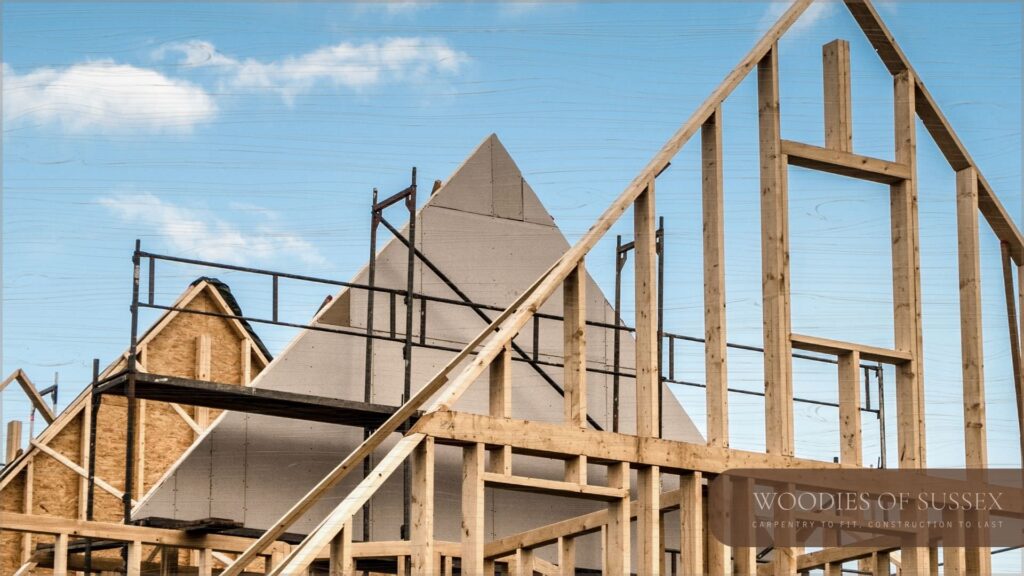
Trimmer joists carry the redistributed load from any joist cut to form an opening – a staircase, a Velux, a hatch. Part A requires them to be sized up to take that extra load. In practice that almost always means doubling the joist, sometimes tripling it for a wide staircase opening, and connecting the trimmer beam into it with proprietary metal hangers rather than skew-nailing.
The logic is straightforward. When you cut a joist in the middle of a floor to create an opening, the cut joist can no longer span to its bearing point. Its share of the load has to go somewhere, so it gets caught by a trimmer beam, and the trimmer beam passes that load sideways into the two joists either side of the opening. Those two joists are the trimmer joists. They are now carrying their own normal load plus the redistributed load from every joist that was cut – sometimes two or three times the normal imposed load. A single joist is rarely enough.
Connections between the paired trimmer joist members need through-bolted coach bolts or structural screws at regular centres, not just nails. Glue alone is not a Part A detail. Common section we specify on a domestic loft conversion is doubled 47x200mm or 47x225mm C24, bolted at 400-600mm centres with M12 coach bolts and washers. For the full sequence on how this goes together on a live loft job, see our guide on frame trimmer openings on a loft conversion.
What are trimmer beams, and why does Part A ban notching them?
Trimmer beams span across the head and foot of a floor or roof opening, catching the cut ends of the trimmed joists and carrying that load sideways into the trimmer joists. Part A prohibits any notches or holes in trimmer beams because every cut weakens the beam exactly at the point where bending stresses peak – and unlike a standard joist, the trimmer beam has no safety margin built in for notching.
This is the single most common place where trimmer joists and trimmer beams get confused, including in articles that should know better. They are not the same member and they do not do the same job:
- Trimmer joist = full-length joist running parallel to the other joists, either side of the opening, usually doubled
- Trimmer beam = shorter member running perpendicular to the joists, across the head and foot of the opening, catching the cut joist ends
Notches in a trimmer beam are a Part A fail at inspection. If a plumber or electrician needs a pipe or cable past the opening, the service has to route below the beam in the ceiling void, through a service zone built in front of the beam, or back through a parallel joist outside the opening. Not through the beam itself.
Hangers on the beam matter almost as much as the beam size. The trimmer beam sits in long-leg joist hangers fixed to the face of each trimmer joist, and every cut joist end sits in its own face-fix joist hanger on the beam. Every nail hole in every hanger must be filled, with the correct gauge sherardised or galvanised square-twist nail – not just any nail off the bench. Building Control checks this at first fix, and a partially nailed hanger will fail inspection on the spot.

Where do roof trusses fit into Part A?
Prefabricated trussed rafters – the factory-built Fink, attic, raised-tie and scissor designs delivered on a lorry – are an engineered product. The truss fabricator designs them to BS EN 1995 (Eurocode 5), takes responsibility for the Part A calculations, and supplies a certificate with the trusses. The carpenter’s Part A job on a trussed roof is installation and bracing, not design.
That installation work is still inspected. Longitudinal binders, diagonal rafter bracing, chevron bracing and web bracing have to be fitted to the truss manufacturer’s drawing and to BS 5268-3 guidance. Missing bracing is one of the more common Part A failures on a roof inspection, because the trusses stand up fine without it in still weather – the bracing is what keeps them standing in a gale and what transfers wind load down into the wall plates.
Cut roofs – traditional rafter-and-purlin work cut on site – sit in a different Part A conversation and we will cover those in a standalone post shortly. Trussed rafters are a large enough subject that we are pulling them out into their own article rather than crowding this one.
What does Building Control actually inspect on structural carpentry?
Building Control inspects structural carpentry at first fix, before anything is boarded over. The inspector checks joist sizing against the approved drawings, every joist hanger for nail fill and correct type, bolted connections on any doubled trimmer joists, mid-span strutting, and on a trussed roof, the full bracing schedule against the truss supplier’s drawing.
The stages you give notice for are fixed in the Building Regulations (Regulation 15): commencement, excavation before covering, foundation concrete, damp proof course, any drain works, and occupation / completion. For a carpentry-heavy job like a loft conversion, the structural carpentry inspection fits into the stage between damp proof course and completion, and it needs calling in before the ceiling plasterboard or the floor deck go on. Once the work is covered, the inspector cannot see it, and that blocks the completion certificate at the end.
No completion certificate is not a paperwork problem – it is a resale problem. Any conveyancing solicitor on a future sale will flag the missing certificate, any mortgage valuer will downgrade the property, and regularisation after the fact (retrospective sign-off) is expensive and often requires opening the work back up. We do not sign off structural carpentry without the inspection, and neither should anyone else.
Part A sits alongside the other approved documents that apply to the same jobs – Part B fire safety for timber construction, Part L thermal performance in timber builds, and Part M access requirements. A loft conversion or extension is inspected against all four, not just Part A.
The Part A mistakes we see most on site
Most Part A failures we walk into on jobs inherited from another outfit are not complicated. They are the same handful of errors, over and over:
- Skew-nailed joist hangers. Two nails at an angle instead of the full hanger-nail schedule. The hanger looks fine from below and fails the moment you put foot traffic on the floor above. Fill every hole.
- Single trimmer joist at a staircase opening. A single joist does not carry the redistributed load from the cut joists. Doubled as a minimum, tripled for wider spans.
- Notched trimmer beams. A plumber has put a 22mm hole through the middle of the trimmer beam for a radiator feed. That is a Part A fail and the beam has to be strengthened or replaced.
- Joists notched outside the permitted zones. Electricians drilling holes for cables low down in the span, or plumbers cutting top-edge notches at mid-span. The joist is now undersized at the weakest point.
- Self-fabricated “trusses” without a certificate. Someone has nailed up a Fink-shape in the garage and stood it in a roof. There is no fabricator calculation, no gang-nail plate certification, and no Part A compliance route.
- Old undersized joists reused in Victorian terrace loft conversions. Common across Worthing, Brighton, Hove and the older parts of Horsham. Original ceiling joists in a Victorian property were never designed as floor joists, and they usually need sistering or replacement before the new floor deck goes on.
Why it matters
Structural carpentry disappears under boarding, plasterboard and flooring the week after it is finished, and nobody ever sees it again. That is exactly why it has to be right first time. A properly sized joist, a correctly built trimmer frame, and a Building Control inspector signing off at first fix is the foundation for thirty years of a floor that does not bounce, crack or fail.
If you are planning a loft conversion, extension or any project involving structural carpentry across Sussex and want a clear read on what Part A will ask of the work, get in touch. We are happy to walk you through what your project needs before a single joist is cut.
Frequently Asked Questions
Does Part A apply to an internal stud wall I’m adding as a carpenter?
Yes, but only to the extent the wall does structural work. A non-load-bearing partition that just divides a room sits under Part A in principle but passes easily on a standard 89x38mm CLS C16 stud wall at 400 centres. The moment the wall carries load from above – a joist trimmed onto it, a roof purlin bearing down, a floor above landing on its head plate – it becomes a structural wall and Part A sizing, connections and bearings apply. A building inspector or structural engineer needs to sign off the detail.
What grade of timber do I need for floor joists under Part A?
C16 kiln-dried regularised softwood is the standard grade for most domestic floor joists at moderate spans. C24 is specified where the span is pushed, where the imposed load is higher than the 1.5 kN/m² habitable baseline, or where a smaller section is needed in a tight depth. For most loft conversions we default to C24 because the span table gives more headroom, and the depth constraint in a loft is usually tighter than in a new-build floor.
Can I notch a joist to run a pipe?
Within strict limits, yes. Top or bottom notches have to sit in the middle third of the span and be no deeper than one-eighth of the joist depth. Holes through the web have to be on the centre line (neutral axis), between one-quarter and four-tenths of the span from each end, spaced at three diameters or more. Anything outside those rules weakens the joist and is a Part A fail. The safer route on a long run is to drop a service below the joists in the ceiling void or route through a service zone.
Do I need a structural engineer for every trimmer opening?
Not always. For a standard loft conversion opening using doubled C24 trimmer joists and a single trimmer beam within domestic spans, a Building Control officer will usually accept sizing against the TDUK span tables without a dedicated calculation. Once the opening gets larger, the loads get unusual (relocated water tank above, ridge beam bearing down, wide staircase), or the trimmer joist has nothing to bear onto at one end, a structural engineer’s calculation is needed. If in doubt, engineer it – the cost is small against the cost of a rebuild.